What the agent wrote for itself
Both policies below were generated by llama-4-scout at step 100 of a real run, from its own correct and incorrect answers up to that point. The difference between them is the paper’s main finding about when this mechanism pays off.
- Directly address the question. Focus on directly answering the question asked, avoiding unnecessary joins or conditions that do not contribute to answering the query.
- Validate schema and relationships. Verify the schema and relationships between tables to ensure correct joins, subqueries, and conditions are used.
- Precise use of SQL constructs. Choose SQL constructs that accurately handle the query requirements, such as using aggregation or grouping when necessary, and handle edge cases like empty result sets or division by zero.
- Avoid ambiguous or redundant results. Ensure that queries are clear and unambiguous, directly answering the question without providing redundant or unnecessary information.
- Handle multiple results correctly. Ensure correct usage of subqueries, aggregations, and grouping to handle complex queries with multiple results, considering all required columns and potential duplicates.
- Consider cardiovascular diseases for chest pain. When patients report chest pain, especially if it’s described as tedious, heavy, or sharp, and radiates to areas like the biceps, shoulders, or under the jaw, consider cardiovascular diseases such as NSTEMI/STEMI, especially in patients with risk factors like diabetes, high cholesterol, smoking, or family history of cardiovascular diseases.
- Evaluate for anaphylaxis in allergic reactions. In cases of known severe food allergies, recent consumption of allergenic substances, symptoms like swelling, redness, itching, and widespread skin lesions, consider anaphylaxis, especially if accompanied by respiratory distress or cardiovascular symptoms.
- Assess for infectious diseases based on exposure and symptoms. For patients with recent travel history to high-risk areas, contact with infected individuals, symptoms like fever, shortness of breath, and diffuse muscle pain, consider infectious diseases such as Ebola.
Every rule here travels. Schema validation and join discipline apply to the next SQL query whatever it asks about, which is why this run gained 8.5 points over Self-StreamICL on Spider.
How a step works
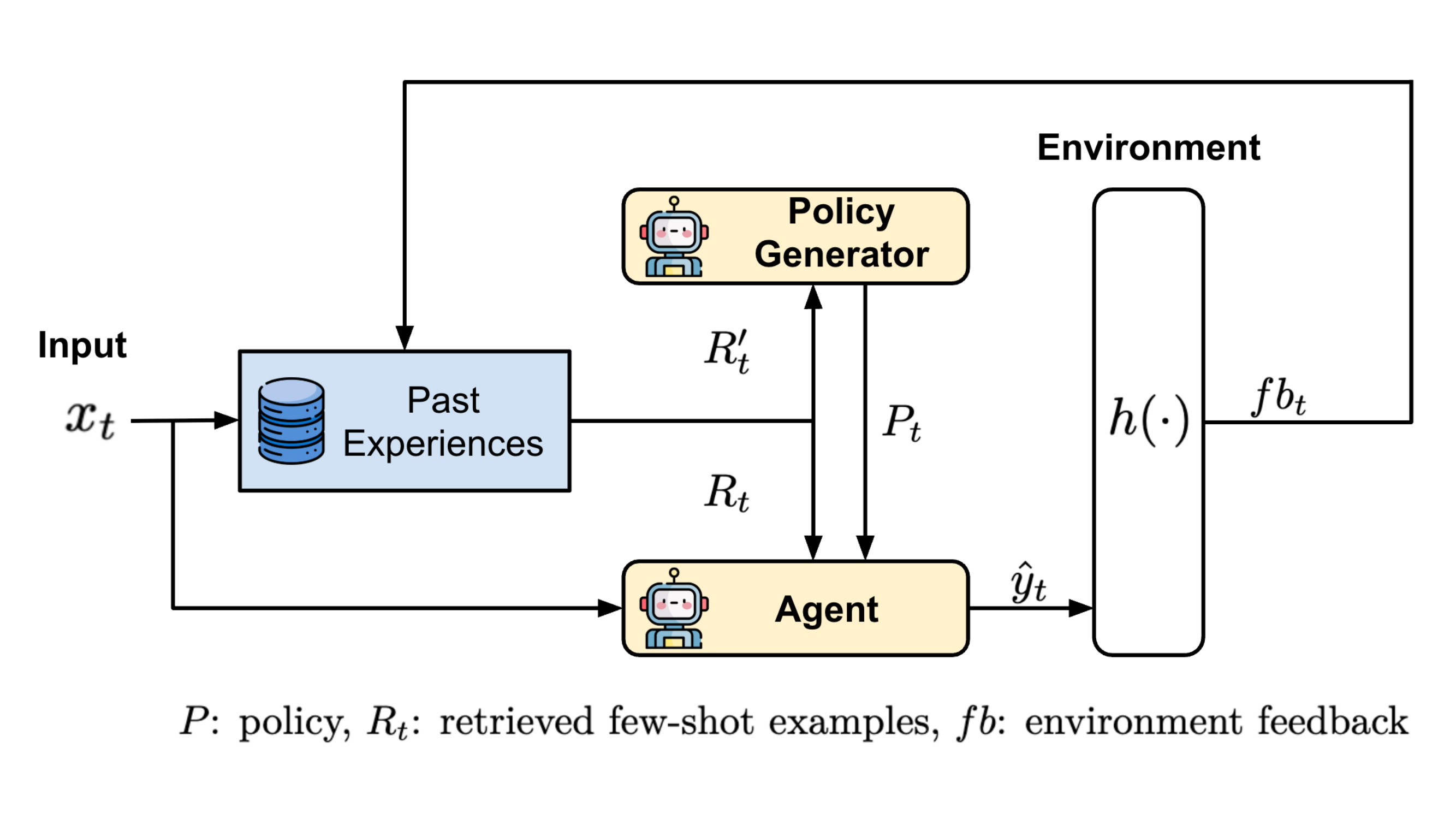
Nothing is trained. The agent keeps a memory of everything it has answered, tagged with the environment’s verdict, and two retrievals run against it: one feeds the agent examples it got right, the other feeds the policy generator an equal number of successes and failures to compare.
# at time step t
R_t   = retrieve(x_t, correct cases)                  # examples for the agent
R'_t  = retrieve(x_t, correct) ∪ retrieve(x_t, wrong)   # k/2 each, contrastive
P_t   = policy_generator(R'_t)                        # up to five rules
ŷ_t   = agent(x_t, R_t, P_t)
fb_t  = environment(x_t, ŷ_t)                         # correct: 1 or 0
memory.add(x_t, ŷ_t, fb_t)
What it costs
Two LLM calls per question instead of one, and two retrievals instead of one. On mistral-medium × Spider that comes to 1,676 input and 143 output tokens per question, against 585 and 17 for Self-StreamICL: about three times the tokens, for a method that needs no gradient updates and no labelled training data.
Where it helps, and where it doesn’t
Seven LLMs across three families (Gemini, Llama and Mistral) on six streaming benchmarks. The counts below are how many of the seven models improved under DRPG against each baseline.
| DRPG against | Spider | CoSQL | BIRD | HotpotQA | DDXPlus | DS-1000 |
|---|---|---|---|---|---|---|
| Zero-shot | 7/7 | 6/7 | 7/7 | 5/7 | 7/7 | 3/7 |
| Self-Refine | 7/7 | 6/7 | 7/7 | 5/7 | 6/7 | 4/7 |
| Self-StreamICL | 7/7 | 6/7 | 5/7 | 5/7 | 3/7 | 3/7 |
Text-to-SQL is where errors are structurally regular, so five rules cover a lot of ground. DS-1000 spans seven Python libraries whose APIs share no common failure mode, and DDXPlus has 49 diagnoses; there the policy collapses into a list of special cases and plain instance retrieval stays ahead. The paper reports full per-cell scores, significance tests, and ablations on retrieval strategy, policy continuity and the environment feedback itself.
Paper, code and contact
The code release contains the DRPG agent, the six benchmark environments, the configs behind every table, and a walkthrough for running it on a model of your own.
BibTeX
@inproceedings{chang2026drpg,
  title     = {Smarter by the Moment: Environment-Driven Dynamic Policies for
               Continual LLM Improvement},
  author    = {Chang, Ting-Wei and Chen, Po-Chun and Huang, Hen-Hsen and
               Chen, Hsin-Hsi},
  booktitle = {Conference on Language Modeling (COLM)},
  year      = {2026}
}
- Questions about the work
- Ting-Wei Chang on LinkedIn